
China’s New Border Controls and the End of the Reform-Era Bargain
Xi Jinping is closing the exits his predecessors opened, reclaiming state leverage over the wealth and talent Beijing cannot allow to escape.

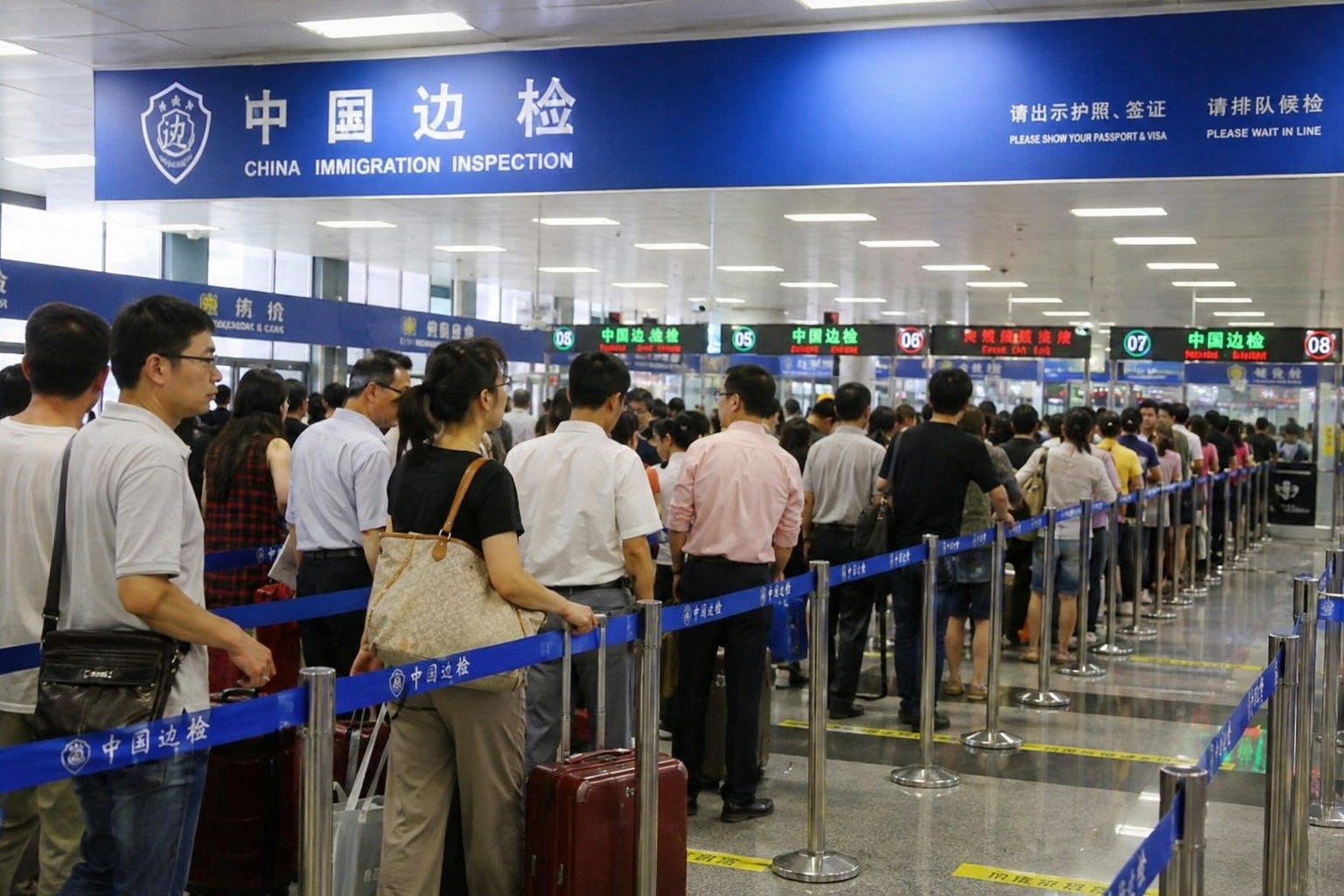
China’s latest exit-entry regulation is part of a coordinated offensive against independent wealth and mobility. The rules arrive alongside crackdowns on foreign brokerage accounts, new taxation of offshore trusts and tighter scrutiny of overseas investment. The purpose is clear: Beijing is methodically closing the routes through which wealthy families, entrepreneurs and skilled professionals can move themselves, their money and their knowledge beyond state reach—a reversal designed to restore the party-state’s leverage over assets and talent it cannot afford to lose.
On June 9, Chinese human-rights lawyer Yu Wensheng traveled with his wife and son to Shenzhen. His wife and son planned to enter Hong Kong, but border officers reportedly told them that their departure could “endanger national security.” They were prevented from crossing and briefly detained. Yu later said that all three members of the family were subject to exit restrictions.
The incident took place before China’s new exit-entry regulation comes into force on September 15. Beijing already has broad powers to prevent citizens from leaving. The new rules give parts of that system clearer procedures, bring migration intermediaries under closer supervision and connect border enforcement more explicitly with technology security and other government controls.
There are quieter signs of a changing atmosphere. Some of my own friends and relatives in China had also told me about how they were “persuaded” to cancel their planned visits to Europe or the United Kingdom in recent months. This kind of informal discouragement, falling short of a formal ban, reflects a growing sense that foreign travel may once again depend on more than a passport, an invitation and a visa.
Across Chinese-language media and social networks, the regulation has prompted competing interpretations over the past week. Some analysts see overdue action against forged documents, migration fraud and the criminal networks behind overseas scam compounds. Others link it to Beijing’s simultaneous crackdown on foreign securities accounts, new taxation of offshore trusts and tightened oversight of outward investment.
Vivian Wu, head of Dasheng Media, has argued that formal control over physical movement can also exert pressure on speech, association and conduct. Other analysts emphasize the financial purpose: the state wants early warning when affluent families prepare to relocate their tax residence, companies and assets.
The most alarmed claims run beyond the legal text. The regulation does not prohibit emigration or impose a general wealth test. Its significance lies in the tools it adds and the policies surrounding it.
Xi’s objective is to ensure that no one with strategic value—capital, talent, knowledge or influence—can independently leave, and the regulation is the enforcement mechanism.
Xi’s government is narrowing China’s independent exit routes. Travel, investment and emigration will continue, but increasingly through channels that Beijing can observe, tax, approve or interrupt. Citizens with wealth, expertise and secure foreign options are harder to pressure; reducing those options restores leverage to the party-state.
What the new rules do
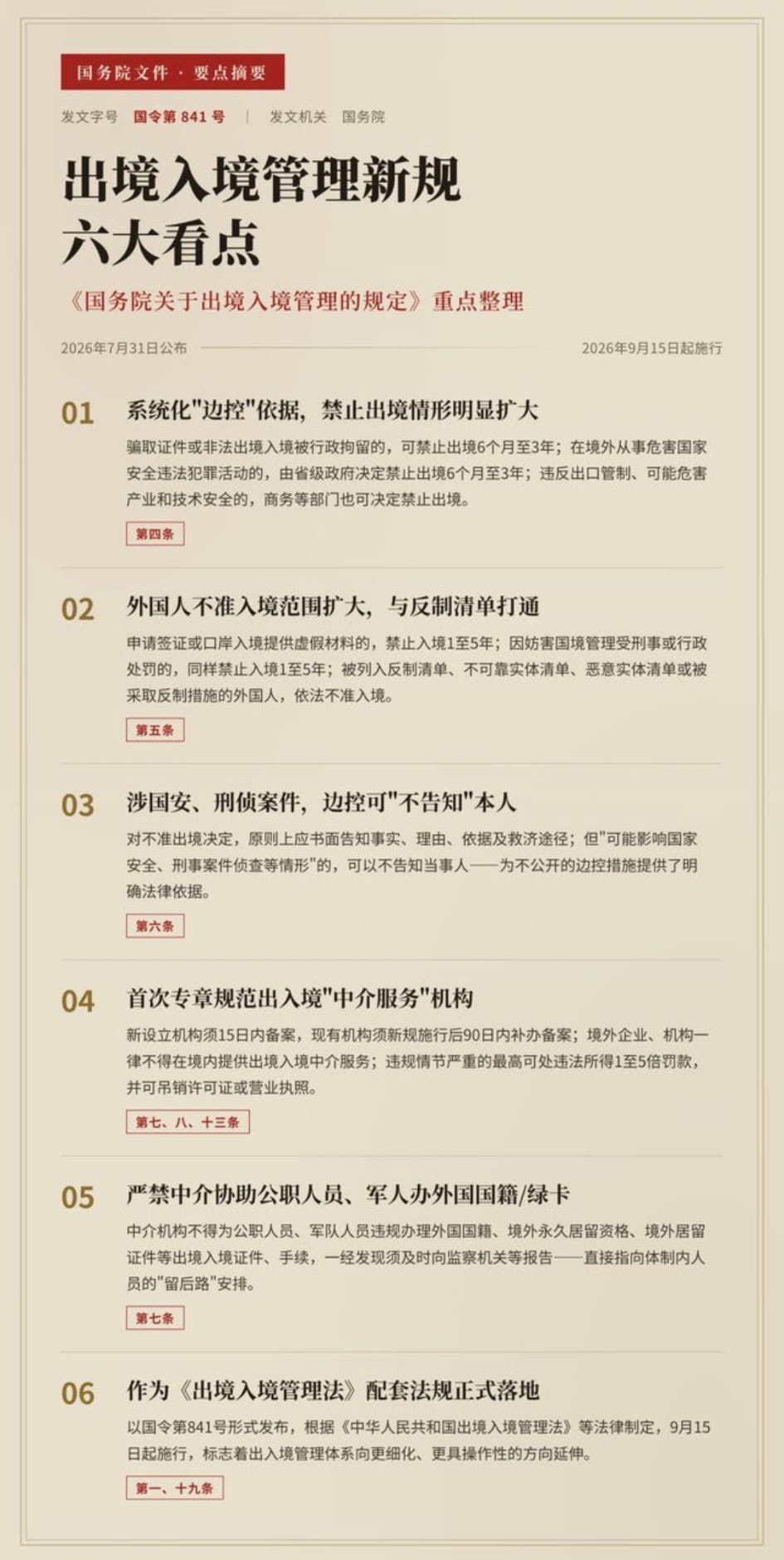
The 19-article State Council regulation requires applications involving exit, entry, residence or stay to have a purpose that is “truthful and lawful.” Immigration authorities may question applicants and request documents, supporting materials and electronic data. The measure supplements the broader Exit and Entry Administration Law adopted in 2012 and implemented in 2013.
Migration, visa and overseas-residence agencies must file with the authorities, preserve records and accept closer supervision. Overseas organizations cannot simply provide those services inside China without a legally established domestic presence. These agencies often know who is preparing to emigrate, where they intend to go and what financial or legal arrangements support the move.
The regulation also sets out restrictions involving fraudulent documents, illegal border crossing, overseas conduct deemed harmful to national security and breaches involving controlled technology or industrial security. In some national-security or criminal cases, notice of an exit restriction may be withheld.
The technology provisions are particularly important. Reuters reported that citizens may be prevented from leaving if the authorities consider them a potential threat to national technology security. A semiconductor engineer, artificial-intelligence researcher or company founder may therefore be viewed as carrying strategic knowledge out of China, rather than simply changing jobs or residence.
What the regulation highlights
Closer examination of travel applications: Officials may seek documentary and electronic evidence that an application is truthful and lawful.
More formal exit restrictions: Temporary restrictions can follow document fraud, illegal crossings, specified overseas offenses or technology-related violations.
Withholding notice in sensitive cases: Authorities may withhold notification where disclosure could affect national security or a criminal investigation.
Supervision of migration agencies: New firms must file promptly, while existing businesses receive a transition period.
Scrutiny of officials’ foreign status: Agencies may not improperly help public servants or military personnel obtain foreign nationality or long-term overseas residence.
Greater coordination rather than wholly new power: China already had extensive exit-ban authority. The new regulation makes parts of the system more explicit and operational.
Why the money interpretation has gained ground
The border rules arrived amid an unusually concentrated financial offensive.
In May, regulators announced penalties against Futu, Tiger Brokers and Longbridge for facilitating cross-border securities trading outside approved channels. Reuters reported that the affected brokers would restrict mainland clients from opening positions, while Beijing directed investors toward supervised mechanisms such as Stock Connect.
The Financial Times reported a proposed fine of 1.85 billion yuan, about $271 million, against Futu, with further penalties for Tiger and its executives.
On July 24, China introduced taxation of offshore trusts. Asset transfers into such structures may trigger a 20 percent tax on gains; income produced through the trust faces annual taxation. Anti-avoidance provisions target people who obtain foreign citizenship while retaining main economic interests in China.
The Wall Street Journal described a broader shift away from offshore arrangements that once allowed Chinese founders to hold wealth in foreign currencies and outside the ordinary mainland system. Beijing increasingly wants foreign listings, investment proceeds and subsequent transactions to pass through supervised channels in which ownership, taxes and capital movements remain visible.
The policies reinforce one another in a closed loop: tax authorities track offshore wealth, securities and investment regulators oversee capital flows, security agencies monitor technology and data, and immigration authorities identify the people and provide the final enforcement point when any branch wants departure delayed or prevented.
Why Xi is doing this now
China is not approaching insolvency. It remains a vast exporting economy with substantial state resources. But fiscal pressure has become much more serious.
The property downturn has weakened land-sale revenue, once a major source of local-government income. Local debt is heavy; aging population increases pension, health and welfare obligations. Slower growth makes previously tolerated tax leakage harder to ignore. China’s fiscal revenue rose 4.7 percent in the first half of 2026, but underlying pressures on local government and the property-dependent revenue model persist.
The financial motive is revenue hunger combined with anxiety about capital flight and confidence erosion.
A wealthy entrepreneur who leaves may take much more than savings. The move can involve company ownership, foreign-listing proceeds, family wealth, future investment and technical expertise. A visible departure can also encourage others to protect themselves in the same way.
Geopolitical rivalry adds urgency. Beijing expects prolonged competition with the United States over chips, artificial intelligence, aerospace, biotechnology and advanced manufacturing. Retaining engineers, data and intellectual property fits preparation for sanctions, technological decoupling or a future crisis.
But beyond revenue and geopolitics lies a political imperative: citizens with independent wealth, foreign residence and secure options abroad are inherently harder to pressure, and for Xi, closing those exits to eliminate a class of people who can resist state demands is not negotiable.
These measures do not prove Xi has decided to launch a war. They would be useful in a Taiwan confrontation or rupture with the West, but they serve immediate peacetime goals: tax collection, capital management, anti-corruption enforcement and political discipline.
The most coherent reading is that Xi is making China more controllable under conditions of possible confrontation, reducing vulnerabilities that could become dangerous during a crisis: capital flight, elite departure, technology leakage and citizens with secure foreign bases.
Movement control through the Communist decades
The historical pattern helps explain why the latest measures have touched a nerve.
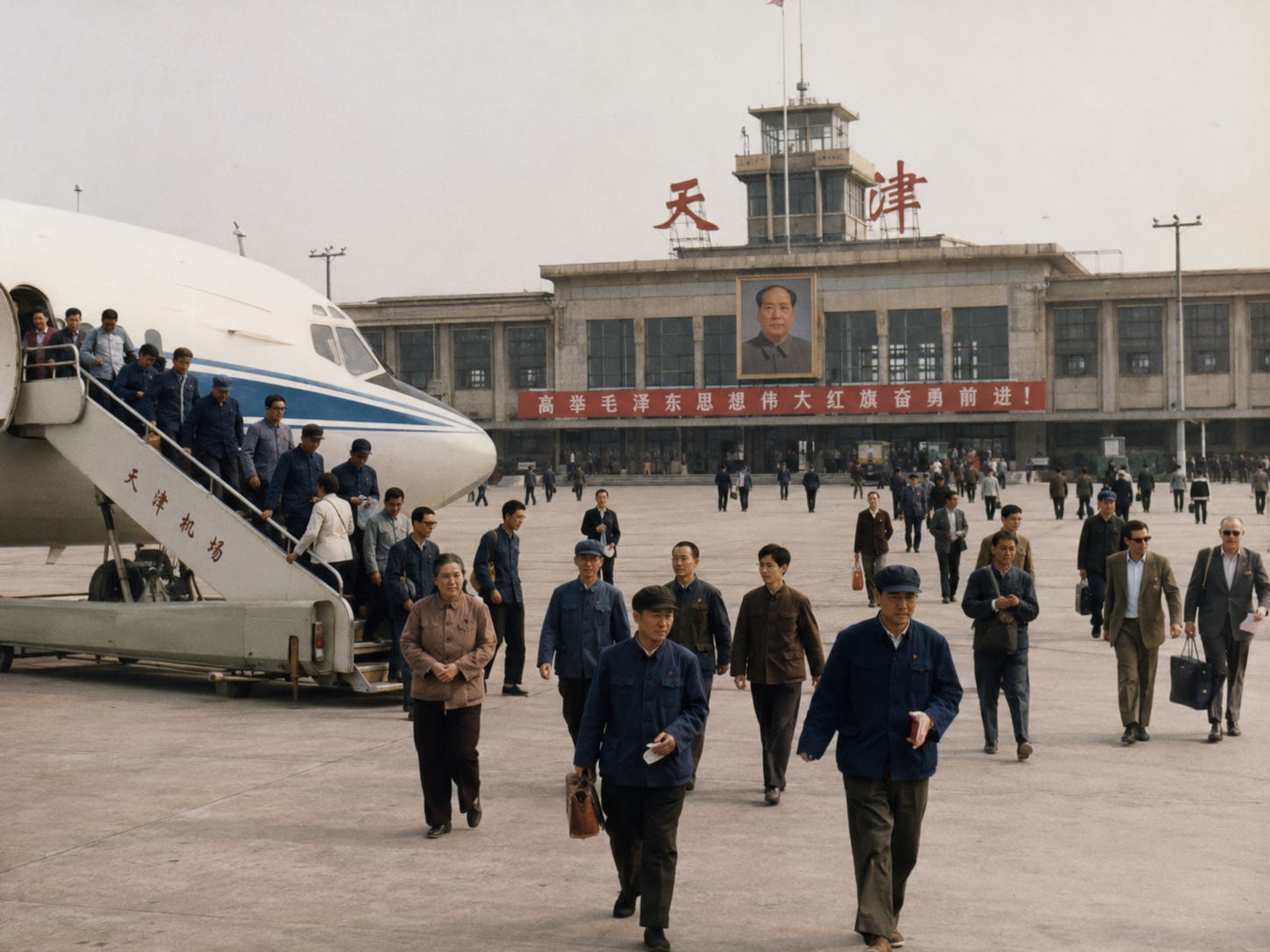
Under Mao, foreign travel was an exceptional political privilege. Passports went mainly to diplomats, official delegations, approved students and state-authorized travelers. Contact with foreigners invited suspicion. Hukou restrictions, work units, political files and state control of housing and employment kept individuals dependent on official institutions.
Deng Xiaoping loosened those controls because isolation had left China poor and technologically backward. During the early 1980s, the ability to meet foreigners, receive an invitation and travel overseas became one of the most tangible signs of reform. Students, businesspeople and families gained access to the outside world because China needed capital, expertise, markets and modern education.
That opening created genuine personal freedom, though on a pragmatic foundation: the party accepted greater autonomy because it produced development and strengthened the regime.
Xi inherited the consequences of that bargain: internationally connected entrepreneurs, private fortunes, overseas families, foreign-educated professionals and citizens with alternatives outside China.
His response has been to place mobility within a national security framework. The 2013 law consolidated exit-ban powers. The 2018 supervision system extended restrictions linked to anti-corruption cases. During the pandemic, ordinary passport issuance was sharply reduced for travel deemed nonessential, demonstrating how quickly movement could become conditional again.
The latest regulation continues that trajectory through more data, more interagency coordination and closer oversight of those preparing to leave.
Who should worry
Ordinary tourists may see little immediate change. Selective enforcement minimizes economic disruption and preserves the appearance of normal international movement.
The highest exposure falls on wealthy families changing tax residence, entrepreneurs with offshore companies, legal representatives of investigated businesses, officials and state employees, politically active citizens, migration advisers and specialists in sensitive technology.
Foreign companies also face personnel risk. An executive can enter China without knowing that a commercial dispute, tax inquiry or security investigation may later bar departure. Universities and technology companies must weigh whether research collaboration, conference travel or relocation could be reframed as technology-security risks.
For overseas Chinese with vocal criticism of Beijing, the calculus has fundamentally shifted. A diaspora journalist, activist or academic with public positions on Tibet, Xinjiang, Hong Kong or party politics now faces genuine material risk in returning to visit family, conduct research or attend conferences. What was once an inconvenience—managing CCP sensitivities during a visit—has become a serious threat.
What is likely to happen next
The tightening will advance through administrative practice rather than dramatic announcement.
Migration agencies will likely be required to provide more client information. Passport applicants in sensitive sectors will face closer questioning. Tax and foreign-exchange investigations will more often produce exit restrictions. Technology-security provisions will be tested against founders, scientists and engineers making lawful career moves.
Wealthy Chinese with foreign residence, compliant offshore structures and assets already outside China retain some options. New applicants face a narrower path, with fewer independent routes available.
Their independent options are narrowing rapidly as foreign brokerage routes close, offshore structures face greater disclosure and taxation, overseas investment channels through approved routes only, migration intermediaries become visible to the state, and tax, civil, criminal and security cases all affect the ability to depart.
The next stage will reveal whether these powers remain concentrated on obvious fraud, undeclared wealth and sensitive technology. A deeper economic downturn, capital flight or a geopolitical crisis could encourage broader use.
The reform era gave Chinese citizens room to travel, build wealth and create lives outside direct political supervision. Xi’s New Era is reclaiming that space. Its governing principle is now clear: international movement may continue at scale, while the people, money and knowledge Beijing deems important remain within reach.
This reminds me of the slow tightening the screws that was done on Hong Kong. The pressure is slow but relentless until the state figures it literally snap the trap, or country, closed and stifle any residual dissent. Nothing new here. These are the folks who made hay while the sun shone, happily staying quiet when the state’s boot was on someone else’s neck. Oops…karma. Such a bitch.
More Canadians think China is a good alternative to America despite this. The White People try to whitesplain to me that human rights is a Western concept so it's bad. I'm not White to be clear